|
| The
French and the world... |
|
 |
|
|
|
| Diplomacy and foreign policy |
|
The French and the power of France |
|
A few Facts
& Figures about French
diplomacy :
-
In spite of her size (only 1%
of the population of the world), France maintains the largest
diplomatic network of all countries with 163 embassies
worldwide (twice the budget of Foreign Office, see detailed
figures).
-
With troops under UN
or NATO command, France is very active in several peace-keeping
operations (Afghanistan, Ivory Coast, Chad, Lebanon, to name
a few, plus Mali on her own) ; in 2008, they represented around 15,000 troops (plus approx.
20,000 in countries with military agreements with France and
in overseas territories. The number of troops (2020) is 10,000+ in operations, 7 or 8,000 in overseas territories and 4 to 5,000 in permanent bases ouside France. To maintain her international ambitions, France has the 5th military budget in the world (in 2011 : USA 711 billion Euros, China 143, Russia 71,9, UK 62,7, France 62,5, Japan 59,3, India 48,8, Saudi Arabia 48,5, Germany 46,7, Brazil 35,4) (Source : Le Monde 5/3/2013).
-
Very often France is more
visible than her size or her actions would seem to merit.
For instance, in 2008 before the Olympic Games in Beijing, there
were demonstrations all over the world for the liberty in Tibet,
including in France. The Chinese government was very upset and
punished ..... France (removal from travel guides, freeze on
most ongoing negotiations, "spontaneous" popular demonstrations
in front of French department stores in China, etc...). Why?
America is too big and can retaliate, Germany is too necessary
for her exports, Sweden is too small, etc... By slapping France,
the Chinese got the best cost / efficiency ratio. In 2003, many
countries opposed the stupid US war on Iraq but State Secretary Rice
said : "Forgive Germany, forget Russia, punish France". Do you remember the US campaign against the "cheese eating surrender monkeys" (who happened to be right on this particuliar issue ...)?
- More to come....
|
|
This is a banal statement but it is difficult for the French to admit that France is no longer what she was in the 18th Century : a big country (when it was the most populated country in Europe and second or third in the world), a powerful country (when all educated people spoke French) and its leadership was challenged only by Britain.
-
There is no doubt that most of the French people over-estimate the power and the influence of France (see : "how do they see their own country") but there is no doubt either that most Americans under-estimate France ! 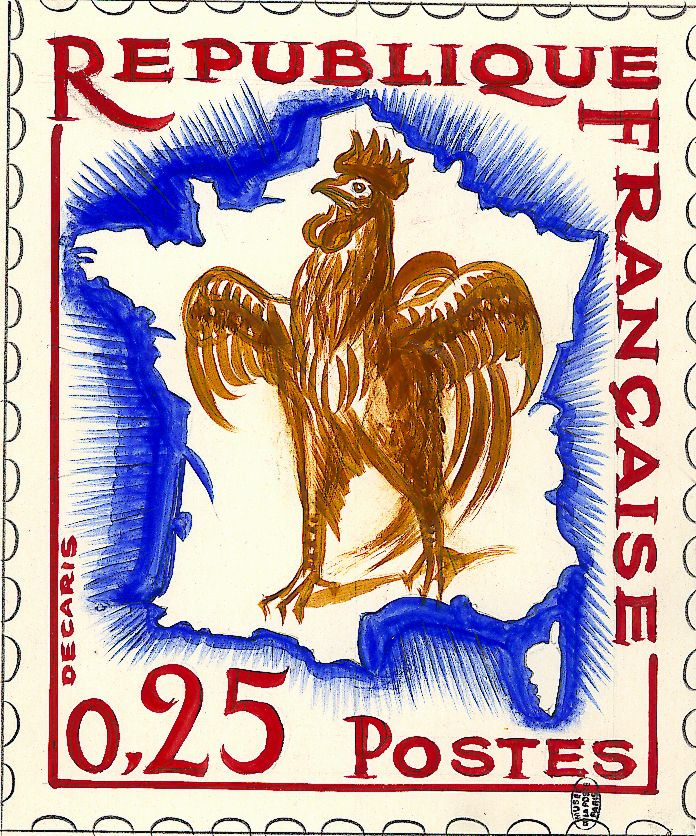 (this was a project for a stamp in the 1970s : it was considered too arrogant, and dropped !) (this was a project for a stamp in the 1970s : it was considered too arrogant, and dropped !)
-
Why ? It is a fact that, in spite of her wealth but given her size France cannot compete with super-powers like the USA or even China. But the country has other factors of power and knows how to use them : her image, her history, her language, her culture. You may call it soft-power!
-
However, the loss of preeminence is a real frustration and contributes to the low national mood (read a comment about it by a former Director General of WTO).
- Their language is very important for the French and Francophonia is one of the key-elements of soft-power : read about it!
DID YOU KNOW THAT.....? American are not the only people one could suspect of being too insular. Like many other people (and maybe more...) the French tend to consider that what they do and think is the only think that matters to the world : read an anecdote about this Franco-centrism.
|
What do they think?
Some ideas, obvious for 99% of the French, are, let's say, less obvious for the rest of the world. Among them :
- "France is the homeland of the Rights of Man"
- "Paris is the capital of the world" (and "the Champs Elysees, the most beautiful avenue in the world")
- "Europe is like France, just bigger"
- "Everybody in other countries loves and admires France and the French"
- "France must express a position on any issue in the world" because "the world is expecting the position of France on the matter"
- and many more ...
But, please be indulgent! Some other countries also sincerely believe that they are the center of the world : the French call that nombrilisme (i.e. belly-buttonism). Like any other country, the French have totems, such as laws or historical characters, which are respected by everyone. They also venerate some sacred cows and forbid to kill them, as harmful as they can can be. Read more about their totems and their sacred cows. |
|
The French overseas
-
Emigration : there is no historical tradition of emigration in France and the number of French living abroad is relatively small (2.2 million, according to the most recent official figures).
-
However, more and more emigrants are recorded in the recent years : wealthy people (read about taxes in France) and young entrepreneurs.
-
Political representation : contrary to many other countries (including the USA...), the French living overseas are very well represented in the French Parliament, with 12 senators and 11 deputies.
-
More to come ...
|
|
Historical roots
You do not understand a foreign policy
if you do not know some of its historical
roots. Remember that,
in Europe, France has always been a rich country (therefore : tempting for
her aggressive neighbors) with a large population (therefore
: naturally aggressive herself) with no protection on most of
her borders (no ocean, no desert, no mountains)
For the French
diplomacy, historical roots include :
-
Islam : France has always had an "Arab policy "
: already in the 16th century, to counterbalance European continental rivals, Renaissance
King François Irst had an alliance with the Sultan of
Constantinople. To challenge Britain, France has always sought
a "special relationship" with Mediterranean countries
(revived in 2008 by President Sarkozy under the name of "
Union pour la Méditerranée ", making Germany
very upset).
-
Language : countries where French is an official
language have a particularly close relationship with France (Quebec,
Belgium, Lebanon, West Africa, Syria,... ). More about Francophonia.
-
Germany : against the German threat, France has developed
relations with Russia, in addition to her old traditional alliance
with Poland and a constant pro-Serbian policy
-
England : against her traditional enemy, Britain, France
has developed alliances with Scotland ("the Auld Alliance"
signed in 1295 : until 1903, all Scots could automatically claim
French nationality!) and with the USA (yes indeed!) during the
Revolutionary War (to name a few....)
-
Africa : a special cooperation with African countries
(some call it "neo-colonialism", including those who
would like to replace France by their own country : guess who?)
; more about French colonies
and "Françafrique"
-
The Ocean or the Continent ? Whereas UK's answer is "the Ocean" and Germany's answer is "the Continent", the French policy has always balanced between them. This explains some unexpected (for her partners) shifts in her policy (Russian policy, colonial policy, relations with the USA, rivalry or alliance with UK or Germany, etc..).
More to come....
|
|
Culture and cooperation
- French
Doctors, the two French
organizations ("Médecins sans Frontières", Nobel Peace prize in 1999, created in 1971 by Bernard Kouchner and
" Medecins du Monde " in 1980) were the first of their
kind. Hundreds of French doctors, nurses and logisticians take
a few weeks off to work in a foreign country with one of them
French schools abroad are a key element of soft power. France maintains over 495 elementary, middle and high schools in 133 different countries ; they have over 250,000 students (1/3 French, only). They give education, the French way. They generally enjoy an excellent reputation, but some critics say that they are ghettos for the wealthiest. They are very much in demand (steady growth, mostly in Asia) and according to a survey in the USA (2009), American parents appreciate some traits of the French educational system like "rigueur" (being very demanding on children) and "apprentissage de l'esprit critique" (teaching being analytical and critical). There are 9 of them in the USA (New York, Los Angeles, San Francisco, Washington DC, Chicago and Houston). More information.
-
The Alliance Française network (1071 chapters in 138
countries, 440,000 students), the 145 French cultural centers
and the 430 " lycées Français " (French
High School) are the most important instruments of the French
cultural policy worldwide and of the "Francophonie".
-
Other European countries have
a similar policy : the British Council, the German with 144
Goethe Institut, the Spanish with Instituto Cervantes, yhe Italian with Italo Calvino.
- More to come.....
Economy
-
The VIE program ("
Volontaire International en Entreprise ", 4,500 in 2006)
is composed of young graduate students who work an average of
17 months in the foreign subsidiary of a French company or in
the Economic Department of a French Embassy ; in 2006, 41% in
Europe (UK, Germany, Belgium, Italy, Spain, ), 22% Asia (China,
Japan, ), 15% North America (USA, Mexico, ), 12% Africa (Morocco,
), 6% Latin America, 4% Middle East.
-
With bureaus in 165 countries and dispatches in 6 languages, Agence France Presse is one of the four international news agencies with AP and Bloomberg (USA) and Reuters (UK).
-
The French economy is very open
to the world :
-
80% of the profit of the 40
largest French corporations (listed on the CAC40) come from outside
France
-
Read the section of French world leaders
-
More to come
-
The French Public Aid for
Development is approximately 3 times bigger as a % of GNP
than the American's. See detailed
figures.
- More to come....
|
| To related pages : history, society, learning French, etc... |
|
To table
of contents
To top of the page
Back to home
page
|
Harriet Welty
Rochefort writes articles and books about France and the French.
Order her books :
- "Joie de Vivre", Secrets of Wining, Dining and Romancing like the French, St.Martin's Press, New York, 2012
- "French Toast, An American in Paris
Celebrates The Maddening Mysteries of the French", St.Martin's Press,
New York, 1999
- "French Fried, The Culinary Capers
of An American in Paris", St.Martin's Press, New York, 2001
More on Harriet's books (excerpts, upcoming
events, testimonials, etc..)
|
| To
email
me |
If you like this site, please bookmark it or create
a link! |
|