|
| French
Literature (#1) |
A good way to understand
the French is to read their literature - or to know a few of
the things that all French children learn in school from kindergarten
(the fables of La Fontaine and the tales of Charles Perrault)
to high school (Balzac, Zola, Molière) |
|
|
|
|
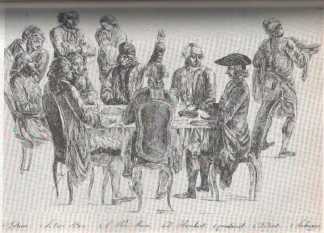 "Le souper des Philosophes",
an eighteenth century engraving starring Voltaire, Condorcet,
Diderot, D'Alembert and others... "Le souper des Philosophes",
an eighteenth century engraving starring Voltaire, Condorcet,
Diderot, D'Alembert and others... |
| Everything
a French high school student knows (or should!).... |
|
Little marvels of French
literature |
-
It is taught in school that
the first piece of French literature (i.e. not in Latin) is La
Chanson de Roland, written at the end of the Xth Century,
which tells the story of the death of Roland, a nephew of Charlemagne.
-
Rabelais (1494-1553) and the myth of Gargantua,
the good giant : when you say something is "rabelaisian",
it means that it's larger than life, funny, perhaps a trifle
scatological, certainly very earthy. There is a long tradition
of Rabelaisian authors
in French literature.
-
Poets : from Middle-Age poets (such as François
Villon, poet and mobster), Renaissance poets (du Bellay or Ronsard),
Romantiques (Lamartine) and Symbolistes (Baudelaire, Verlaine,
Rimbaud
- The phrase,"Heureux qui
comme Ulysse a fait un beau voyage..." by XVIth century
poet du Bellay : the wise man is happy to return to his
little village.
- The poem "Mignonne allons
voir si la rose..." by XVIth century poet Ronsard
: the beautiful rose becomes ugly : time goes by very quickly
and we lose our youth..
- Lamartine : a Romantic writer like Byron: "Salut
bois couronnés d'un reste de verdure..." ou "levez
vous donc, orages désirés..."
-
The reflection about friendship
between men as illustrated by Montaigne's phrase about
la Boétie "Parce que c'était lui, parce que
c'était moi..." (from Les Essais de Montaigne).
-
La
Fontaine (1621-1695)
: his fables are wonderful pieces of universal wisdom through
animals' adventures, brilliant and full of common-sense. Everybody
knows them by rote ; The Tortoise and the Hare, The Raven and
the Fox, Le Savetier et le Financier ("Rendez moi mes chansons
et mon somme et reprenez vos cent écus...") or L'Ours
et l'Amateur de Jardins ("Rien n'est si dangereux qu'un
ignorant ami, mieux vaut un sage ennemi...")
-
Theater :
-
XVIIth century : Molière
(1622-1673) : The French Shakespeare, intemporal ; among the
most famous plays, "l'Avare" is a play you'll enjoy,
even if your French is not very good ;
-
comparing Corneille
(1606-1684) and Racine (1639-1699) is a classical high-school
dissertation; most kids hate it and they better remember the
classical definition : "le héro de Corneille fait
ce qu'il doit, celui de Racine fait ce qu'il se doit"
(the Cornelian character does what he must do (i.e. sense of
duty), the Racinian character does what he owes to himself (i.e.
sense of esthaetics) ; in French a "Cornelian choice"
is a difficult one, when you do not know what is your duty
-
Read about a strange French institution : the "Comédie Française"
- Victor Hugo (1802-1885) is THE writer of the XIXth
Century, with his plays, poems, novels but also the political
role he played. A formidable character.
|
|
Among the lesser known
(at least outside France) pieces of French literature, my
favorites are :
- Ubu Roi (Alfred Jarry, 1873-1907) : Pere Ubu is a cruel tyrant and his wife Mere Ubu is a sort of Lady Macbeth ; a farcical pre-surrealist play about power and greed, very funny and profound ; for the French, a famous US president looks very much like Ubu (guess who)
- Le lys dans la vallée
(Honoré de Balzac,
1799-1850): ideal love, of course purely spiritual, death, etc..
- Les contes du Lundi (Alphonse Daudet 1840-1897) : the first
short story " La dernière classe " :
in Alsace, in 1871, the last class of an old teacher when the
Germans banned the use of French in schools ; he tells the students
how precious their language is to keep their identity
- L'ami Fritz (Erckmann-Chatrian 1822-1899 & 1826-1890)
: life in an Alsatian village in the XIXth century : the story
of a man who just wanted to enjoy life and did not care about
getting married and what happened
- Mon oncle Benjamin (Claude Tillier 1801-1844) : the adventures
of an Epicurian village doctor in the late XVIIIth century, the
good old days,...
- Le silence de la mer (Vercors 1902-1991) : an impossible love
between a young woman and a German officer who is occupying her
house, no word spoken, nothing happens,....
(read about life under German occupation)
- The Fables by Jean de La Fontaine (1621-1695),
wonderful pieces of universal wisdom through animals' adventures.
All French kids learn by rote many of them in school.
More to come...
I realize that most of them are
very sentimental : the French are much less cynical than their
reputation....
You can download many excellent
texts (in French) from the site of
the French government.
DID YOU KNOW
THAT.... Several " Fables de La Fontaine " apply
very well to some of the most irritating sides of the French
: for example,
- "La Grenouille et le Boeuf" (The Frog
and the Ox) is the story a a frog who wants to be as big as an
ox : it inhales as much air as it can to become bigger and bigger
until it explodes (look at the French-USA relation...),
- "Le Coche et la Mouche" (the Coach
and the Fly) is the story of six horses pulling a heavy coach
while a fly is on the nose of the driver, irritating everyone
and pretending that it is the one who is doing the hardest job,
until it is crushed by the driver.. (look at the policy of France with her European partners).
Sounds familiar, doesn't
it ?
USEFUL TIP.......
When you read or hear the classical comment "French literature
does not exist any longer" or "all French books are
alike" (for instance in a cover storty like "The Death
of French Culture", Time Magazine Dec.2007), do not forget
that for most of them, American readers read only what American
publishers buy and translate. If they always buy the same kind
of books, it becomes a self-fulfilling prophecy : all the books
will be alike. It is the same with movies : see a
recent example
of a very good and innovative movie for which the US distributor
considered that "there was no market for it : not enough
French".
|
- Novels : many important XIXth Century writers
- Balzac (1799-1850) and the "Comédie
Humaine", the collection of books which compose his
work give a very accurate description of reality and French character
traits. (The Austrian writer, Stephan Zweig, has written one
of the best biographies of Balzac. A must for Balzac fans.)
- Flaubert's (1821-1880) Madame Bovary is the perfect
example of feminine frustration and the boredom of provincial
life ; Flaubert is famous for his (perfect) style.
- Maupassant (1850-1893) is the master of short
stories
- Alexandre Dumas (1802-1820) wrote historical novels such
as "The Three Musketeers" (he said : "it is permitted
to rape history, as long as you make her beautiful children...")
and the wonderful "Count of Monte Christo"
- Zola (1840-1902) described the lives of poor miners
and their rich and uncaring bosses in Germinal.
-
XXth Century : Sartre
(1905-1980) and Camus (1913-1960) (comparing them is another
classical dissertation), with in addition a philosophical and
political controversy between them. For the French, the most
important book of the XXth century is L'Etranger, by Albert
Camus ; in
addition to Sartre, and his "ethics of commitment",
several writers such as André
Malraux (1901-1976), who fought in the Spanish Civil
War and the French Resistance, wrote about political commitment
;
-
Some writers have fanatic lovers,
for instance Marcel
Proust (1871-1922) ("an allegorical search for truth
in that the narrator recalls the experiences of his past in an
attempt to recapture time lost"), or Louis-Ferdinand
Céline (1864-1961), famous for his incredibly
imaginative style (and his disgusting anti-semitism).
| Contemporary French
novelists include Michel Houellebecq (see picture), probably the most interesting of all, the very
controversial author of Les particules élémentaires or Soumission),
Yasmina Reza, Jean Marie Le Clezio (who was awarded the Nobel
Prize in 2008), Amélie Nothomb, Marie NDiaye, Camille Laurens, Patrick
Modiano, etc... |
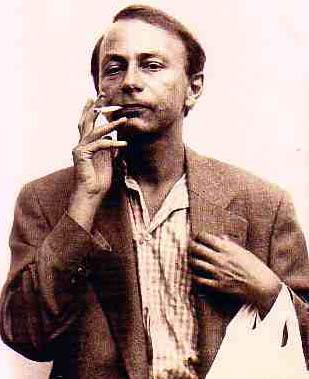 ------M.Houellebecq ------M.Houellebecq |
| More in Taylor.
They are considered part of the group of "les
intellectuels", who appear often on French TV. |
-
To see the whole list of the
50 favorite French authors, click here
-
The "new France" resulting
from immigration
is not only represented by suburban riots. Thanks to ethnic diversity,
there is an incredibly rich new generation of young singers,
movie-makers and
writers. Among them :
- Mehdi Charef, Thé
au harem d'Archi Ahmed
- Faïza Guène, Kiffe
kiffe demain (translated into English), or Du rêve
pour les oufs
- More to come
DID YOU KNOW THAT . . . ? In France, a writer has reached glory when published in the Collection de la Pleiade (by Gallimard, publisher). In this prestigious collection, the books are small (4.2 x 6.8 i.), have a thin high quality paper (papier bible) and can reach 2,000 pages, with top quality printing and binding. Each book can contain more than twenty novels or plays. Above all they have always an excellent and long presentation of the author and his/her work. They are expensive but definitely worth it. Among the 800 books, only a few were published during the lifetime of the author.
|
|
Famous characters from
French literature
Often used in Hollywood or Walt
Disney movies :
- Blue-Beard ("Barbe Bleue"), Cinderella
("Cendrillon"), Sleeping Beauty ("La
Belle au Bois Dormant"), Little Red Riding Hood
("le Petit Chaperon Rouge") and many others
come from "Les Contes de ma Mère l'Oye",
by Charles Perrault (1628-1703)
- The Little Prince ("Le Petit Prince")
was created by writer and pilot Antoine
de Saint-Exupéry (1900-1944). Translatefd into 361 languages, it is the second largest circulated book after the Bible.
- The
Hunchback of Notre-Dame
("Quasimodo") comes from "Notre-Dame
de Paris", by Victor Hugo (1802-1885)
- The Three Musketeers ("Les Trois Mousquetaires")
is a novel by Alexandre Dumas (1802-1870)
- More to come
Some characters are so wonderfully
designed that they became household names :
- Cyrano de Bergerac from Edmond Rostand (1868-1918) : generous, brilliant,
sentimental with "panache" (and famous for his enormous
nose...)
- Gargantua from Rabelais (1494-1553) : epicurian,
voracious, truculent
- Harpagon from Molière (1622-1673) : miserly
- Tartarin de Tarascon from Alphonse Daudet (1840-1897) : Southerner,
bragging, ridiculous and generous.
- Tartuffe from Molière (1622-1673) : hypocritical,
false pious,...
- More to come
Do not forget : the new
literature in French by non-French writers
-
Many illustrious
foreign-born writers lived in France and wrote/write directly
in French. Among them Samuel Becket (Irish), Eugène
Ionesco
(Romanian), Fernando Arrabal, Jorge Semprun or Michel Del Castillo
(Spanish), Tahar Ben Jelloul (Morrocan), Andrei Makine or Arthur
Adamov (Russian), Milan Kundera (Czech), Eduardo Manet (Cuban),
Marek Halter (Polish), Emil Cioran or Panaït Israti (Romanian),
Hector Bianciotti (Argentinian), Ismael Kadare (Albanian), Simenon (Belgian), Elie
Wiesel (Hungarian), François Chen (Chinese), Julien Green
or Jonathan
Littell (American,
Goncourt Award 2007), Enki Bilal (Yougoslav), Vessilis Alexakis
(Greek), Anna Moï (Vietnam), etc... See a page on American
writers
in Paris.
-
An increasing
number of excellent writers from Francophone countries are invited
to speak and studied in the French Departments of US universities
(see Le Monde, March 20, 2008)
-
As an example,
in 2008, three of the most prestigious French literary awards
went to non-French writers : Atiq Rahimi (Afghan, Goncourt Award),
Tierno Monembo (Guinean, Renaudot Award) and Seymus Dagketin
(Turk, Theophile Gautier/Académie Française Award)
-
Contrary to what many Americans believe, the French are very open to other cultures : music, cinema, literature including American literature (read an anecdote about it)
-
More to come....
|
| Visit the places they
lived ... |
|
Literature and anti-Semitism |
|
A "lieu de mémoire"
(place of memory) is not a museum (because it does not necessarily
include objects of high artistic value) but rather the place
where someome famous lived and worked. The following writer's
homes can be visited:
In or near Paris :
- Emile Zola : Médan (20
miles NW of Paris)
- Victor Hugo : 6 Place des Vosges
(in "le Marais")
- Honoré de Balzac : his
house 47 rue Raynouard (16th arrondissement)
- Chateaubriand : beautiful romantic mansion
and 30-acre park in La Vallée aux Loups (5 miles S of Paris)
- Alexandre Dumas : romanesque
Chateau de Monte-Christo in Port Marly (5 miles W of Paris)
- Jean-Jacques Rousseau : Montmorency (20 miles N of Paris)
- More to come
Foreign writers
- Ivan Turgueniev : a Russian
datcha in Bougival ( 5 miles W of Paris)
- More to come
Outside the Paris Region
- Pierre Loti : an eccentric house
in Rochefort-sur-Mer (on the Atlantic coast)
- Marcel Proust : the house where
he spent his vacations as a kid, Illiers Combray (near Chartres,
70 miles W of Paris)
- Jules Verne : Nantes (one hour
and a half with the TGV)
- Pierre Ronsard: in Tours, you
can visit the remains of the abbey where he lived
- More to come
Visit a site devoted to writers' houses and literary collections (all over France).
Literature and history : some novels give the best description
of an historical situations or contexts. See
a list of French novels with a very strong historical background.
Click here for other places of memory (sculptors, musicians, etc).
DID
YOU KNOW THAT. ? The French like comic books (B.D., for " Bandes Dessinées "), a very developed industry
in France and in Belgium with all sorts of books (mystery, but
also science fiction, erotism,etc...). Different from the American
comic books and from the Japanese mangas, the Franco-Belgian
"bandes dessinées" are a literary form in itself,
with more than 4,000 books published every year. The most "
classic " authors are Hergé (with his astute reporter,
Tintin), Morris (with Lucky Luke, the cowboy), Gotlib or Reiser
(with their devastating Rabelaisian humor), Jacobs (with Blake
et Mortimer), Goscinny & Uderzo (with Asterix the Gaul), Peyo and
his Stroumpfs (translated : Smurfs in English), but also Petillon,
Wolinski, Enki Bilal and Cabu to name a few, and the mythical
characters such as Corto Maltese, Largo Winch, Titeuf (the insolent
anti-hero), etc... The " Festival International de la Bande
Dessinée " in Angoulême is a well-known annual
event (January) and the magazine Pilote was a (distant) cousin
of Mad ; today the left-wing weekly Charlie Hebdo still represents
this tradition. Only ignorant French-bashers can write that the French
like BDs because they are not capable of reading a "real"
book! Read more about comic strips in France.
The most despicable French writers !
Some French writers, although considered major authors, were despicable human beings even if certain bad aspects of their life or of their personality may be denied or forgotten. If you want to impress your French friends, you may incidentally mention the following (of course they are my purely personal choice!). Among them :
- Jean-Jacques Rousseau (1712-1778), the most famous 18th century philosopher was probably the most influential and the most important to explain the French Revolution ; among his books, he wrote L'Emile, a book about how to educate children to make them free and responsible citizens. He had five children and abandoned them to an orphanage...
- Louis-Ferdinand Celine (1894-1961) is one of the most important writers of the 20th century and, often compared to James Joyce, he invented a new language in his books, full of lyricism, sarcasm and crude images. He was also a passionate and violent anti-semitic writer and, as opposed to his masterpieces like Le voyage au bout de la nuit, several of his books are just nauseating. (more about literature and anti-semitism)
- Jean-Paul Sartre (1905-1980) is probably the most famous French philosopher of the 20th century. His work includes major philosophical works, plays and novels. He was awarded the Nobel prize in 1964 (and refused it). He was the political guru of a whole generation from the 1950s to his death and he constantly advocated supporting communism (he wrote : "an anti-communist is a dog", the most scornful word you can find in French) and although he knew perfectly well about Stalinism and the gulag he never said anything negative about it (he wrote : "you can't drive Billancourt to despair", i.e. this (emblematic) city of workers should never know about it). More about Sartre.
- Louis Aragon (1897-1982) is a poet and a novelist. One of the founders of the surrealist movement in France (dadaism) in the 1920s, he was also a journalist and a political activist. As a poet, he wrote some of the most delicate poems of the French literature (listen to a wonderful one by singer Leo Ferré ). He wrote several brilliant novels (Les Beaux Quartiers, La Semaine Sainte, etc). As a journalist, he was the publisher of the Communist newspaper Les Lettres Françaises from the end of the war to 1972. As a political activist he was the most devoted stalinists of the Communist Party of which he was one the leaders for decades and he was instrumental in all of its errors and crimes like extending the (legitimate) purge of the French collaborationists to some of the political adversaries of the Communist Party, defending the Soviet regime whenever criticized (the trials in 1930s, the Nazi-Soviet treaty in 1939, the Gulag, the invasion of Hungary and Czecoslovaquia when the rebelled, etc). A talented poet and a despicable apparatchik.
- more to come...
|
|
Can you be a great writer and a despicable person ?
The dramatic events of WW2 raised the old question : can you dissociate an artist from his/her work? In the 1930s,two writers among others, wrote terrible anti-Semitic articles and books and even worse (if possible) during the four years of German occupation (1940-1944). The first one, Robert Brasillach (1909-1945) was considered the most promising novelist of his generation and several of his books (which contain nothing questionable about anti-Semitism) are still largely read and deserve it, although he was (1937-1943) the publisher of a disgusting anti-Semitic magazine, Je Suis Partout. He was sentenced to death and shot, General de Gaulle having refused his pardon (in spite of a call for pity signed by some of the most respected writers of that time, among them some major figures of the Resistance).
The second writer raises an even more complicated problem : Louis-Ferdinand Celine (1894-1961) is considered by many one of the most important writers of French literature. He created a language of his own, his style is inimitable and his most famous book "Voyage au bout de la nuit" (Journey to the End of the Night",1932), is probably one of ten or twenty most important books in French literature. The entire work of Celine is now published inthe most famous French collection (La Pleiade) along with the greatest French writers. In 1944 he escaped to Denmark and he came back only in 1950 and he received a mild sentence. He was a despicable person, bitter, full of hate and he never apologized for the horrible books he wtrote and the hateful statements he made about the Jews. But he is indeed a great writer. More about anti-Semitism..
If you want to impress your French girl/boyfriend
Just make, incidentally ,one of the following remarks and she/he will admire your familiarity with French literature. Any reasonably educated French person is more or less familiar with the following suggestions.
-
IF suddenly a little detail reminds you of something really important in your past life, JUST SAY : "c'est ma Madeleine de Proust" (literally :"it is my Proustian cake") : in his enormous work A la recherche du temps perdu (Rememberance of Things Past, Marcel Proust (1871-1922) is eating a Madeleine, a soft delicate cake, and suddenly he remembers when he was a little boy and his aunt Leonie baked them for him and his whole youth comes back to him (for the next 200 pages…);
-
IF you have to make a very difficult decision between two contradictory options JUST SAY "c'est un choix cornelien" (literally "it is a Cornelian choice"): in his play Le Cid, Pierre Corneille (1606-1684) analyzes the situation where his hero, The Cid, must avenge his father by killing his insulter who happens to be the father of Chimène, his lover girl ;
-
OF someone really cheap, SAY "he is a veritable Harpagon" (the main character of Molière's play, L'Avare (1668)) and OF someone who is seeking a revenge after many years, SAY "il est comme le Comte de Monte Christo" (the character of Alexandre Dumas (1802-1870) who, under this name, gets revenge on those who treated him cruelly twenty years before ;
-
(this is only for a French girlfriend) IF your girlfriend is frustrated and keeps telling you that she deserves a better life, JUST SAY "don't be Madame Bovary" : the famous character of Stendhal's (1783-1842) hates her life in a small village in Normandy with her boring husband and has a disatrous affair with another man
-
IF somebody is describing a situation of extreme poverty (and you are becoming bored….), JUST SAY "c’est du Zola" (literally "this is straight from Zola") : Emile Zola (1840-1902), the French equivalent of Charles Dickens described the situation of factory workers and their families at the worst of the Industrial revolution ;
-
IF you are in front of something really absurd and illogical (for instance a tax decision of the French Government…), JUST SAY "c'est ubuesque", a reference to Père Ubu, a cruel and illogical tyrant, the character of a very funny play by Alfred Jarry (1873-1907) ; in addition, it gives you a very good opportunity to exercise your pronunciation of the French "u" ;
-
IF you are in the midst of a situation where you do not understand what is going on because you are too close to the events, JUST SAY "je suis comme Fabrice del Dongo à Waterloo" (literally "I am like Fabrice del Dongo at the Waterloo battle") : Stendhal's (1783-1842) hero of La Chartreuse de Parme happens to be present on the battlefield of the last defeat of Napoleon and is unable to understand what is happening around him, because it's too close;
- more to come
DID YOU KNOW THAT ? In 1969, Georges Perec, a highly respected novelist, wrote a lipogram. You don't know what it is ? It is a 300-page novel without, not even once, the letter "e". It was translated into English (under the title : A void) and the title in French is La Disparition. Surprisingly, it is a good novel...
A chain of literary hotels offers an environment associated with a particular writer (books, artifacts, pictures, furniture, literary events). Three hotels in Paris (around Marcel Proust, Arthur Rimbaud and Marcel Aymé). A fascinating experience for lovers of French literature. |
|
| To related pages : more literature (#2), French culture, bibliography, education, French
songs, French movies, etc... |
|
To table
of contents
To top of the
page
Back to home
page
|
|
Harriet Welty
Rochefort writes articles and books about France and the French.
Order her books :
- "Joie de Vivre", Secrets of Wining, Dining and Romancing like the French, St.Martin's Press, New York, 2012
- "French Toast, An American in Paris
Celebrates The Maddening Mysteries of the French", St.Martin's Press,
New York, 1999
- "French Fried, The Culinary Capers
of An American in Paris", St.Martin's Press, New York, 2001
More on Harriet's
books
(excerpts, upcoming events, testimonials, etc..)
|
 |
|
| To
email
me |
If you like
this site, please bookmark it or create a link! |
|